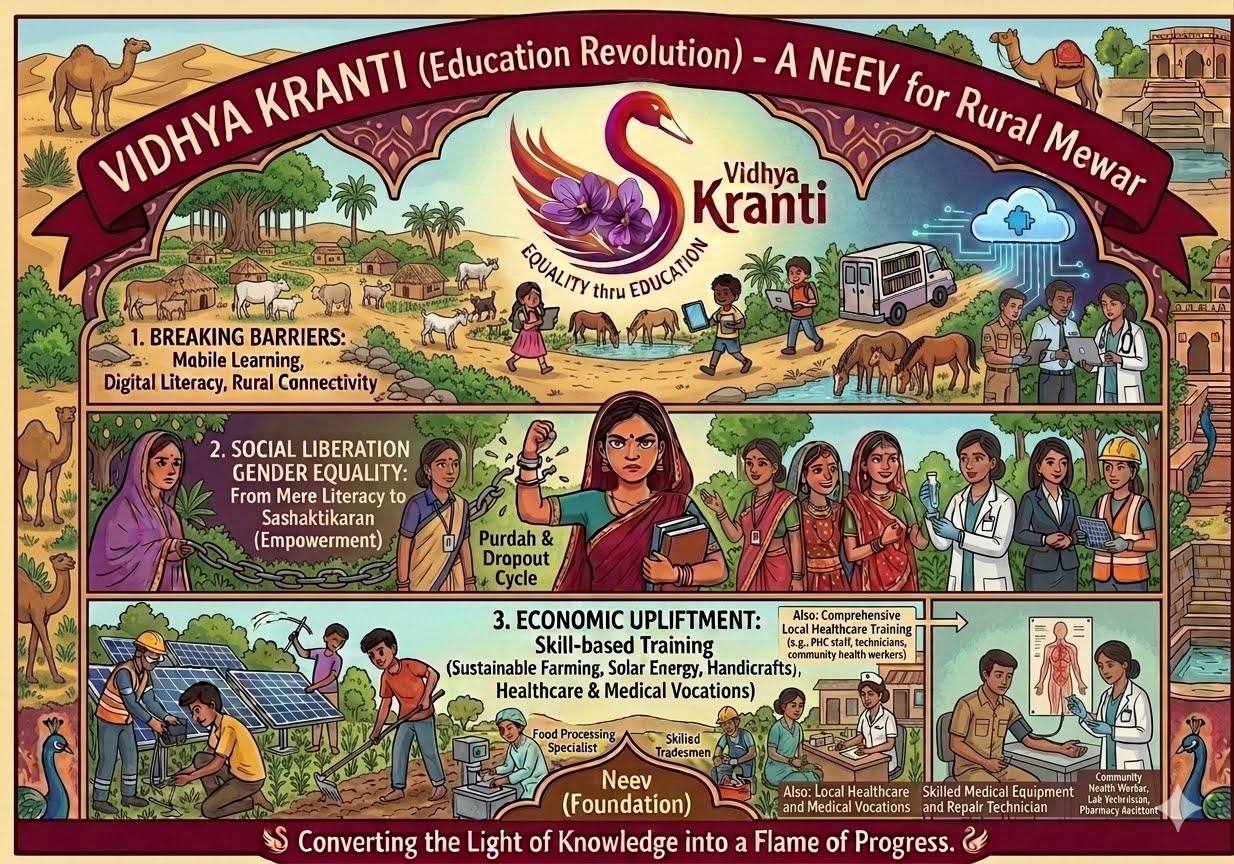
Vidhya Kranti (Education Revolution) is not just a name; it is a vital necessity for the socio-economic transformation of rural Mewar-Rajasthan. In a region defined by its vast geography and deep-rooted traditions, this "revolution" represents the bridge between a storied past and a digitized future.
The significance of Vidhya Kranti lies in three critical areas:
1. Breaking Structural and Geographical Barriers
Rajasthan-Mewar is a large region, characterized by scattered settlements (dhanis) where schools are often kilometers away. A "revolution" in education implies moving beyond traditional brick-and-mortar limitations. Vidhya Kranti advocates for mobile learning, digital literacy, and improved infrastructure to ensure that a child in rural Mewar has the same access to quality content as a student in Jaipur or Udaipur.
2. Social Liberation and Gender Equality
For decades, rural Mewar has grappled with high dropout rates among girls due to early marriage and the purdah system. Vidhya Kranti serves as a social catalyst. By framing education as a "Kranti" (uprising), it challenges the status quo, empowering families to view a daughter’s education as a matter of pride and economic independence rather than a social burden. It shifts the narrative from mere literacy to Sashaktikaran (empowerment).
3. Economic Upliftment and Migration Control
Rural Mewar faces a cycle of debt and seasonal migration. Vidhya Kranti focuses on skill-based learning and vocational training that is relevant to the local economy—such as sustainable farming, solar energy, and handicraft entrepreneurship. By educating the youth within their cultural context, the movement creates a "Neev" (foundation) for local jobs, preventing the forced migration of unskilled labor to urban slums.
Conclusion
The name Vidhya Kranti resonates because it acknowledges that incremental change is no longer enough. To overcome the weight of historical illiteracy and the challenges of a harsh landscape, Mewar requires a bold, revolutionary spirit. It is a call to action for every village to turn the "light of knowledge" into a flame of progress, ensuring that the next generation of Mewaris is defined not by their hardships, but by their Vidhya (knowledge) and Swayam-Siddha (self-reliance).
विद्या क्रांति: ग्रामीण मेवाड़-राजस्थान के बदलाव की एक नई राह
"विद्या क्रांति" सिर्फ एक नाम नहीं है, बल्कि राजस्थान के ग्रामीण मेवाड़ की तरक्की के लिए एक बहुत बड़ी ज़रूरत है। यह पुरानी परंपराओं और आज के डिजिटल दौर को जोड़ने वाला एक मजबूत पुल है।
इस क्रांति के तीन मुख्य स्तंभ हैं:
1. दूरियों की दीवार को तोड़ना
मेवाड़ एक बहुत बड़ा इलाका है जहाँ घर और ढाणियाँ काफी दूर-दूर बसी हैं। यहाँ स्कूल पहुँच पाना अक्सर मुश्किल होता है। विद्या क्रांति का मतलब सिर्फ स्कूल की इमारत बनाना नहीं, बल्कि मोबाइल और इंटरनेट के ज़रिए पढ़ाई को हर बच्चे तक पहुँचाना है। इससे गाँव के बच्चे को भी वैसी ही अच्छी शिक्षा मिल सकेगी जैसी जयपुर या उदयपुर के बच्चों को मिलती है।
2. सामाजिक बदलाव और बेटियों को बराबरी
दशकों से मेवाड़ के ग्रामीण इलाकों में पर्दा प्रथा और कम उम्र में शादी की वजह से लड़कियों की पढ़ाई बीच में ही छूट जाती रही है। विद्या क्रांति एक सामाजिक आंदोलन है। यह परिवारों की सोच बदल रहा है ताकि वे बेटी की शिक्षा को बोझ नहीं, बल्कि गर्व और आत्मनिर्भरता का प्रतीक समझें। यह सिर्फ साक्षरता नहीं, बल्कि सही मायनों में 'सशक्तिकरण' है।
3. आर्थिक सुधार और पलायन पर रोक
मेवाड़ के गाँवों में लोग अक्सर कर्ज और काम की तलाश में बाहर जाने (पलायन) को मजबूर होते हैं। विद्या क्रांति युवाओं को ऐसे हुनर सिखाने पर ज़ोर देती है जो उनके काम आएँ—जैसे आधुनिक खेती, सोलर एनर्जी और हस्तशिल्प। जब युवाओं को गाँव में ही रोज़गार के अवसर मिलेंगे, तो उन्हें मजबूरी में शहरों की ओर नहीं भागना पड़ेगा।
निष्कर्ष
विद्या क्रांति यह बताती है कि अब छोटे-मोटे बदलावों से काम नहीं चलेगा। सदियों के पिछड़ेपन और कठिन हालातों को बदलने के लिए एक बड़े बदलाव (क्रांति) की ज़रूरत है। यह हर गाँव के लिए एक पुकार है कि वे शिक्षा की रोशनी से तरक्की की मशाल जलाएं, ताकि मेवाड़ की अगली पीढ़ी अपनी मजबूरियों से नहीं, बल्कि अपनी 'विद्या' और 'आत्मनिर्भरता' से पहचानी जाए।